By industry
  By role
  By use case
  Customer Success
  Implementation
  Training & Development
  Partner Program
  Partner Finder
  Flare Employee Benefits
 9 things to know about ELMO’s two-way sync between HR and Payroll
Say goodbye to entering the same information in multiple systems. ELMO’s payroll two-way sync now…

 Platform
  Hire
Hire  Schedule
  Pay
Pay  Develop
  Plan
Plan This year’s Budget reveals New Zealand is redirecting some of the country's sharpest, most policy-literate professionals into the open market.
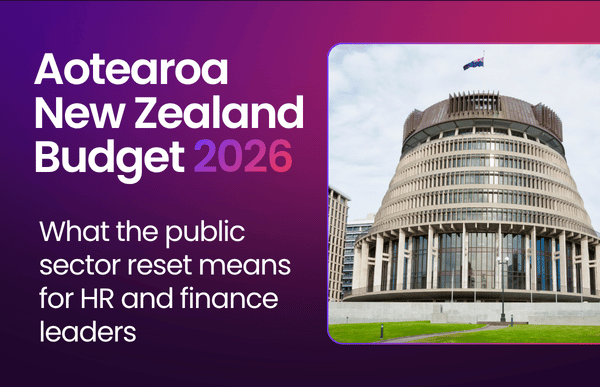
On 28 May 2026, Finance Minister Nicola Willis delivered Budget 2026, a package focused on fiscal repair, frontline services, infrastructure, temporary fuel-pressure support, and reforms in energy security, housing and planning.
For CPOs, HR leaders and teams, this creates a different kind of Budget story: a potential influx of experienced policy, programme, compliance, digital and operational talent into a market where many organisations are still struggling with capability gaps, productivity pressure and constrained hiring budgets.
The Budget also carries a message that CFOs shouldn’t ignore. Alongside the workforce reset, the Government has made it clear that fragmented systems, duplication and outdated back-office processes are now under direct scrutiny.
In its pre-Budget overhaul announcement, Nicola Willis has shared, “A more connected and digitally enabled public service will improve services, reduce duplication, and deliver better value for taxpayers.“
Budget 2026 sets in motion one of the most significant restructures of New Zealand’s public service in decades. Agency operating budgets are being cut by 2% in the coming year, followed by 5% in each of the two years after that, generating $2.4 billion in savings to be redirected to health, education, infrastructure and defence. The country’s core public service will shrink from 63,600 to 55,000 full-time roles by mid-2029, a reduction of 8,700 FTE positions.
The cuts will be delivered through a mix of:
This reset is not only about reducing headcount, it’s also about reducing duplication. The Government’s overhaul programme explicitly targets digitising customer-facing and back-office functions, streamlining agencies and restoring public service numbers to historic norms.
Reporting on a proactively released Public Service Commission briefing suggests that includes standardising HR and payroll systems across government, with expected long-term savings from reducing duplicated procurement, legal and configuration costs.
That matters because private-sector boards and CFOs are likely to ask similar questions of their own workforce technology stack: where are we paying for overlap, complexity and manual work that no longer makes commercial sense?
New Zealand Finance Minister Nicola Willis described the public servants affected as “smart, hardworking and qualified” and signalled that the private sector is where they’re headed next.
The timing also aligns with private sector needs. ELMO’s 2026 HR Industry Benchmark Report (HRIB) shows that skills and labour challenges are already across New Zealand’s key industries. The public sector talent pool arriving over the next three years could ease pressure at exactly the right moment.
With 32% of construction HR leaders naming upskilling, cross-skilling or reskilling as their biggest challenge, and 21% facing an active labour shortage, the sector has appetite for skilled operations, project and programme management professionals.
The average cost per hire in construction is currently $16,589, and new hires reach full productivity in around 32 days (27% faster than the Australian average). Acting quickly here pays off.
30% of manufacturing HR leaders cite cyber and data security threats as their top challenge, and 23% are managing reduced budgets and resources. Government digital and technology specialists (especially those with AI or cloud transformation experience) are a natural fit for manufacturers now being pushed to modernise.
Healthcare HR is under legislative pressure, with 25% of leaders naming compliance and regulatory change as their biggest challenge. Policy and compliance professionals from health-adjacent agencies (Ministry of Health, Pharmac, ACC) are uniquely placed to add value fast.
With the average cost per hire in healthcare at $16,973 and time-to-productivity around 40 days, reducing mis-hire risk through strong cultural alignment matters.
The window of opportunity is now open. Here’s where to focus:
Map your current workforce gaps — skills, roles, level — against the profile of public sector talent entering the market. Where do you have open or anticipated vacancies that this cohort could fill?
Many of the best candidates will not present as conventional private-sector hires. Their value may sit in judgement, process rigour, stakeholder management, policy literacy or transformation experience rather than direct sector tenure. If your hiring criteria are too narrow, you will miss the point of this talent wave.
The best candidates from restructured agencies will have multiple options. Hiring processes with too many stages or slow decision cycles will lose them. Streamlining structured assessments and reducing time-to-offer is a competitive advantage right now.
Don’t just slot new public sector hires into a generic onboarding programme. Create a structured 60–90 day transition experience that accelerates the culture and commercial orientation shift. On time-to-productivity starts the moment someone walks through the door.
Budget 2026 also reinforces the push for consolidation. In the Government’s public-service overhaul announcement, ministers explicitly linked better value for taxpayers to reducing fragmentation, duplication and outdated back-office processes.
Separate reporting on a proactively released Public Service Commission briefing suggests that HR and payroll standardisation is part of that agenda, with projected long-term savings from reducing duplicated procurement, legal and configuration costs.
For CFOs, the implication is clear: the cost of running multiple disconnected systems is likely to come under more scrutiny, especially where those systems overlap across hiring, onboarding, payroll, reporting and workforce management.
Your organisation could be running four or five disconnected point solutions. Work with HR and IT to surface where the organisation is paying for overlapping functions across recruitment, onboarding, learning, performance and payroll. Help define what ‘good’ looks like commercially, and to own the business case once the findings are in.
The Public Service Commission is expected to save $160 million through consolidating legal, procurement, configuration, and other costs. The message is clear: running multiple disconnected systems costs more than it appears on any single invoice.
Map what you’re spending across licensing, IT overhead, vendor management and data reconciliation, and work out what that looks like on a single connected platform. The savings case becomes obvious quickly.
Tech consolidation and talent strategy are more connected than they appear. The same platform that reduces your software spend also gives your CPO better visibility into workforce capability, faster hiring pipelines and more consistent onboarding. Frame the conversation with your CPO early. This is one of the moments where CFO and CPO goals point in the same direction.
Budget 2026 does not automatically create a private-sector consolidation mandate. But it does sharpen the market logic behind one. When duplication, inefficiency and fragmented systems are being challenged so publicly in New Zealand, it becomes easier for CFOs and boards to ask whether their own operating model is carrying avoidable complexity. Organisations that move decisively in the next 12 months will be better placed to absorb the incoming talent wave, reduce ongoing siloed costs and show clearer return on workforce investment.
The most relevant part of Budget 2026 for many HR leaders is not the headline spending. It is the likely reallocation of talent.
If the Government follows through on its public-service workforce target, New Zealand employers may see a larger pool of experienced, policy-literate and transformation-ready professionals entering the market over the next few years.
For organisations in sectors like manufacturing and healthcare, that creates a timely opportunity to strengthen capability in areas where HR teams are already under pressure. The window is not about hiring opportunistically, it’s hiring strategically.
For organisations in sectors like manufacturing and healthcare, that creates a timely opportunity to strengthen capability in areas where HR teams are already under pressure. The window is not about hiring opportunistically, it’s hiring strategically.
Capturing and converting this talent wave into lasting organisational value requires a connected workforce infrastructure that supports smart hiring, fast onboarding and structured development from day one.
ELMO’s Complete AI Workforce Platform helps mid-sized organisations replace multiple costly single-point solutions with one connected platform. That means HR teams can close capability gaps faster, move on the right candidates before competitors do, with a clear cost consolidation story at the same time.
Whether you’re a CFO or CPO navigating the pressures of Budget 2026, a complete HR platform makes a competitive and commercial decision.
From closing skill gaps, upskilling talent and retention, ELMO brings everything you need together into one connected platform.

Budget 2026 announcements have not yet been legislated and may change. All measures are subject to the passage of the relevant Appropriation Bills through the Aotearoa New Zealand Parliament. The information in this publication is for general information purposes only and does not constitute legal, financial or professional advice. For advice specific to your organisation’s circumstances, please consult a qualified professional.”