By industry
  By role
  By use case
  Customer Success
  Implementation
  Training & Development
  Partner Program
  Partner Finder
  Flare Employee Benefits
 9 things to know about ELMO’s two-way sync between HR and Payroll
Say goodbye to entering the same information in multiple systems. ELMO’s payroll two-way sync now…

 Platform
  Hire
Hire  Schedule
  Pay
Pay  Develop
  Plan
Plan 25 capabilities that separate AI-mature HR from AI-native HR
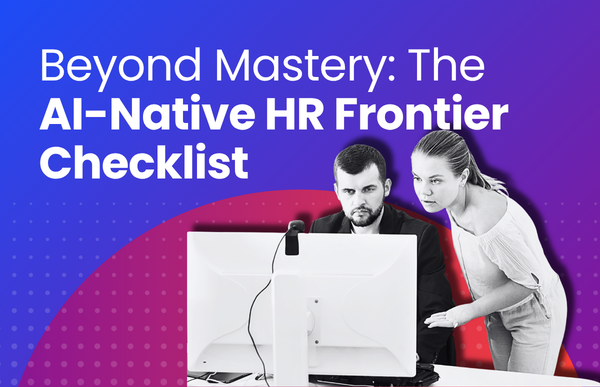
Your AI Maturity Assessment placed you in the Master archetype with both high readiness and high effectiveness. You’re amongst 15% of HR leaders across Australia and New Zealand who have built strong data foundations, embedded AI into everyday workflows, and delivered measurable strategic impact.
You’ve earned that position.
But the frontier is moving fast. What defined mastery twelve months ago is becoming table stakes. Agentic AI, hybrid human-AI workforces, and AI-native job design are already reshaping what “advanced” looks like, and the organisations that stay ahead will be the ones who see the next horizon before it arrives.
This checklist is designed to test the edges of your capability. It covers five domains that define the AI-native HR frontier in 2026 and beyond. Be honest with yourself. The gaps you find aren’t failures; they’re your next competitive advantage.
Read each statement. If you’re actively doing it today (not planning to, not thinking about it — doing it), tick the box. If not, leave it blank. Count your ticks at the end.
The shift from AI as an assistant to AI as an autonomous operator is the single biggest change in HR technology right now. Multi-agent systems are moving HR from task automation to end-to-end workflow orchestration, where AI doesn’t just help you do work, it manages entire processes independently.
☐ You’ve deployed or are piloting AI agents (not just chatbots) that autonomously execute multi-step HR workflows, such as end-to-end onboarding, candidate screening-to-scheduling, or employee service request resolution, with human oversight at defined decision points.
☐ You’ve mapped which HR processes are agent-ready by classifying tasks across your function as AI-autonomous, AI-primary/human-review, human-primary/AI-assisted, or human-exclusive.
☐ You’re building or commissioning custom AI agents tailored to your organisation’s specific workflows, policies, and data, not just using off-the-shelf tools with default configurations.
☐ You’re actively measuring the proportion of work handled by AI agents versus humans across key HR functions, and using that data to inform capacity planning, workforce design and investment decisions.
☐ Your HR team includes (or is developing) “citizen developers”, non-technical HR professionals who can build, configure, or manage AI-powered workflows and automations without relying on IT.
AI doesn’t just change how work gets done; it changes what work is. The most advanced HR functions are redesigning jobs from the task level up, rather than simply layering AI onto existing role descriptions.
☐ You have conducted a task-level audit of your top 10–15 roles (by headcount or strategic importance), classifying each task as AI-autonomous, AI-primary/human-review, human-primary/AI-assisted, or human-exclusive.
☐ You have redesigned or are actively redesigning at least three job families to reflect AI-augmented workflows, not just adding “uses AI tools” to existing position descriptions, but fundamentally restructuring responsibilities, skills requirements, and performance expectations.
☐ You are modelling the impact of AI on role volume and composition over a 2–5 year horizon, including which roles will shrink, which will emerge, and which will transform, and feeding this into workforce planning.
☐ You have created new roles specifically for the AI era — such as AI workflow coordinators, prompt engineers, AI ethics leads, or AI capability coaches, that didn’t exist in your organisation previously.
☐ Your competency frameworks and capability models have been updated to include AI-native skills (prompt design, AI output validation, human-AI collaboration, data interpretation, AI governance literacy) alongside traditional HR competencies.
The concept of “workforce” is expanding beyond humans. Leading organisations are beginning to treat AI agents as members of the operating model — with defined roles, accountability structures, and performance expectations sitting alongside their human counterparts.
☐ You are beginning to account for AI agents as operational capacity in your workforce model — moving beyond treating them solely as tools, and starting to plan, resource, and measure AI-driven work alongside human contributions.
☐ You’re actively designing workflows where humans and AI agents handle distinct steps in shared processes — with clear handoff points, escalation paths, and defined human oversight for AI-generated outputs.
☐ You have established governance for AI agent “performance” — including monitoring agent outputs for accuracy, bias, and quality; defining SLAs for agent-driven processes; and maintaining human override capabilities.
☐ You are preparing managers to lead hybrid teams through targeted development in areas like AI-augmented decision-making, managing human-agent workflows, interpreting AI-generated recommendations, and maintaining team trust and psychological safety in an AI-augmented environment.
☐ Your employee value proposition and engagement strategy account for AI’s presence — addressing concerns about job displacement, clarifying how AI changes (rather than threatens) roles, and positioning AI fluency as a career accelerator rather than a compliance requirement.
Masters are already using AI for workforce planning and scenario modelling. But the true frontier is using AI to fundamentally reimagine the HR function itself, and the organisation’s workforce architecture, for a world that looks very different in 2028–2031.
☐ You have a documented 2–5 year AI transformation roadmap for HR that goes beyond “adopt more AI tools” — covering how the HR function itself will be restructured, what capabilities you’ll need, and how your operating model will evolve.
☐ You are running scenario models on AI’s impact on your industry’s workforce — not just your own organisation — including how AI disruption in adjacent sectors, supply chains, or customer behaviour will change the talent and skills you need.
☐ You are actively contributing to enterprise-wide AI strategy at the C-suite or board level, bringing workforce intelligence, capability forecasting, and human-AI integration expertise to strategic planning conversations that extend beyond HR’s traditional remit.
☐ You have established a continuous horizon-scanning capability — systematically monitoring emerging AI applications, regulatory developments (such as the EU AI Act, Australian AI governance frameworks), and industry shifts to identify opportunities and risks before they become urgent.
☐ You are prototyping “future state” workflows — testing how specific HR processes or business functions would operate in a fully AI-native environment, even if full deployment is 12–24 months away, to build institutional learning and identify integration challenges early.
At the Master level, governance isn’t just about having a policy. It’s about building the institutional infrastructure that allows AI to scale safely, ethically, and with sustained organisational trust, and using your position to influence the broader industry.
☐ You have a cross-functional AI governance body with representation from HR, IT, legal, security, and business leadership. This group meets regularly, has a clear mandate, and actively influences (not just advises on) decisions about AI deployment, risk and investment.
☐ You have processes in place to monitor AI systems used in hiring, performance, compensation, or workforce planning for bias, accuracy and quality — including regular reviews, clear ownership, and reporting to leadership on findings and actions taken.
☐ You’re tracking and preparing for AI-specific regulatory requirements relevant to your jurisdiction — including workforce-related provisions of frameworks like the EU AI Act, ISO/IEC 42001, and emerging Australian and New Zealand AI governance standards.
☐ You’re contributing to external AI thought leadership — through published content, speaking engagements, industry working groups, or peer networks — sharing your organisation’s AI journey and helping shape the broader conversation about AI in HR.
☐ You’re measuring and reporting on AI’s impact beyond efficiency — tracking metrics like employee trust in AI, AI-related capability uplift, ethical incident rates, and the strategic value of AI-generated workforce insights, not just time savings and cost reductions.
Count your ticks and find your tier below.
You’re operating at the genuine cutting edge of AI-native HR. Very few organisations in ANZ are where you are, and the challenge for you is staying ahead as the field accelerates. You’re not just using AI strategically, you’re redesigning the function around it. Your next move is to lead the conversation externally and shape where the industry goes next.
You’ve built exceptional foundations and you’re delivering real strategic value with AI. But there are significant frontier capabilities you haven’t activated yet.The gap between where you are and where the frontier is heading represents your biggest opportunity for competitive advantage over the next 12–24 months.
You’ve mastered the fundamentals, and that’s genuinely impressive. Most HR functions in Australia and New Zealand haven’t reached where you are today. But the capabilities on this checklist represent where the industry is heading in the next 2–3 years, and the distance between current mastery and frontier mastery is larger than most leaders realise. The good news? Your strong foundations mean you’re better positioned than almost anyone to close that gap, if you start now.
Wherever you scored, the frontier won’t wait.
The organisations that lead the next era of AI in HR won’t be the ones with the most AI tools. They’ll be the ones that redesigned how work itself gets done, blending human judgment with AI capability into something neither could achieve alone.
Want to see the Complete AI Workforce Platform™ in action?