By industry
  By role
  By use case
  Customer Success
  Implementation
  Training & Development
  Partner Program
  Partner Finder
  Flare Employee Benefits
 How to choose payroll software for a growing Aotearoa New Zealand business
Payroll is often judged by one simple question: did everyone get paid on time? But…

 Platform
  Hire
Hire  Schedule
  Pay
Pay  Develop
  Plan
Plan AI adoption is accelerating. Boards are asking questions. Employees are already using tools their organisations haven't approved. And somewhere in the middle of it all, HR is being asked to take the lead on governance, often without a clear framework to work from.
It’s a familiar pressure. HR functions are already managing more than ever: hiring, compliance, wellbeing, payroll, psychosocial safety, and now AI strategy. The question isn’t whether your organisation needs an AI policy. It’s how you build one when you’re already stretched thin.
To coincide with our attendance at the NSW HR Leadership Summit, we’ve put together two free resources to help HR teams start — and start well.
An AI policy doesn’t need to be perfect to be useful. It needs to be clear, fit for purpose, and owned by the right people.
Our template is structured around nine core principles that reflect the expectations of responsible AI use across Australian and New Zealand organisations:
The template also covers governance structures, roles and responsibilities, authorised and prohibited uses, data handling and intellectual property, access controls, incident management, and guidance on adapting the policy to your sector, jurisdiction, and risk appetite.
It’s intentionally generic, built to be shaped to your organisation rather than applied as-is.
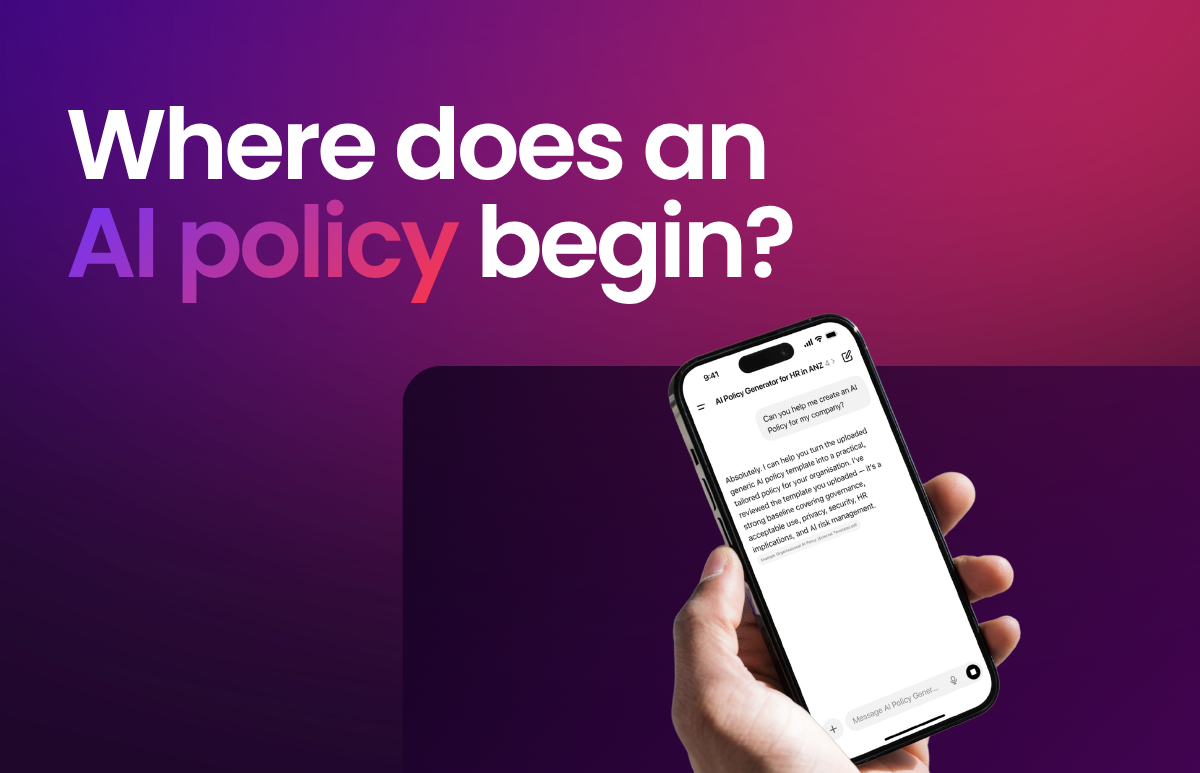
The template gives you the structure. The agent helps you make it your own.
Built by ELMO’s Chief People Officer Anne Tosky, the AI Policy Generator is a guided conversational tool designed specifically for HR practitioners in Australia and New Zealand. Rather than presenting you with a document to fill in, it asks you the right questions — about your organisation’s size, risk appetite, existing policies, and the AI tools your teams are already using — and helps you shape a policy that reflects how your organisation actually works.
Think of it as a thinking partner for the first draft.
If you’re new to AI governance, start with the template. Read through it and notice where the gaps are between what it describes and what exists in your organisation today. Use the agent to work through the questions that feel hardest to answer.
You don’t need a finished policy to make progress. You need a starting point — and a clear sense of what you’re trying to protect.
Both resources are free. No form to fill in. Just a practical place to begin.
If you’re new to AI governance, start with the template. Read through it and notice where the gaps are between what it describes and what exists in your organisation today. Use the agent to work through the questions that feel hardest to answer.
You don’t need a finished policy to make progress. You need a starting point — and a clear sense of what you’re trying to protect.
Both resources are free. No form to fill in. Just a practical place to begin.