By industry
  By role
  By use case
  Customer Success
  Implementation
  Training & Development
  Partner Program
  Partner Finder
  Flare Employee Benefits
 9 things to know about ELMO’s two-way sync between HR and Payroll
Say goodbye to entering the same information in multiple systems. ELMO’s payroll two-way sync now…
 Platform
  Hire
Hire  Schedule
  Pay
Pay  Develop
  Plan
Plan A well-run redundancy process is built in three phases: a structured planning framework with a clear business rationale and role-led (not person-led) decisions; leader preparation including scripts, rehearsal and Q&As; and sustained communication after the announcement to rebuild trust with remaining employees. The process begins weeks before the meeting and continues well after letters are issued.
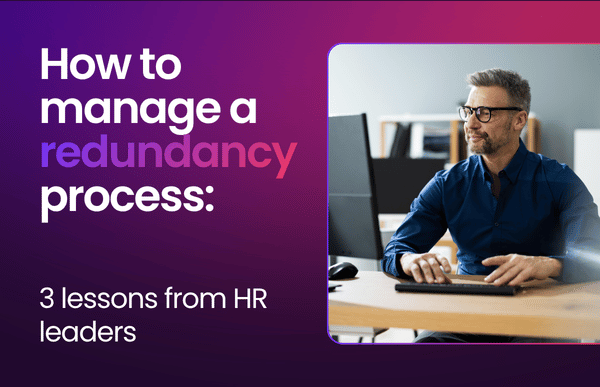
Redundancies and restructures are never easy, but unfortunately, they’re part of the HR landscape. That was the starting point for our first In the Room session with ELMO’s Head of P&C, Helen Tran and CEO of Red Wagon Workforce Solutions, Susan Sadler, which focused on three areas in particular: a framework that makes the hard days manageable, preparing leaders and yourself, and what happens after the announcement.
Across the discussion, one point came through clearly: while a restructure may begin as a commercial or operational decision, the way it’s handled quickly becomes a trust moment for the organisation. People remember whether the process felt clear, fair and human, not just the final outcome.
One of the most useful parts of the session was the reminder that a redundancy process should not begin with the meeting itself. It begins well before that, with a clear rationale, a defined future state and a realistic planning runway.
Helen spoke about the value of a structured approach in the weeks leading up to execution. That included making sure everyone involved understands the business imperative behind the change, mapping the future state, comparing that with the current structure and then working through the communications and transition plan needed to support it.
That planning phase is where HR plays a critical role. Leaders may be focused on org design and business goals, but HR is there to bring the people lens, the behavioural lens and the fairness lens to the process. It is also where HR needs to hold the line on one of the most important principles raised in the webinar: redundancy decisions must be role-led, not person-led.
That distinction matters. If a process starts drifting into personalities, preferences or performance workarounds, it creates risk quickly, both legally and culturally.
The second major theme was leader preparation. During the webinar, we described this as preparing leaders and yourself, and the discussion brought that to life in practical terms.
Helen and Susan were both clear that leaders need more than a meeting invite and a talking point or two. They need structure, rehearsal and support. That includes leader enablement materials, Q&As, clear scripts, role-play where needed and practical coaching on how to respond when emotions run high.
One of the strongest lines from the session was Susan’s point that “the care is in the clarity”. In other words, being empathetic does not mean being vague. Leaders need permission to be human, but they also need to be direct. If the message is softened too much, it can create confusion at exactly the moment people most need clarity.
Helen also made the point that leaders should lead with the most important message first. Once someone hears that their role is at risk, their attention shifts immediately to the practical and personal consequences. That is why the opening lines matter so much, and why the meeting should not be cluttered with unnecessary preamble.
Just as importantly, the session acknowledged the emotional load on HR and people leaders. These are difficult conversations to prepare for and difficult conversations to carry. A good process does not remove that reality, but it does make it easier to navigate with consistency and care.
The third learning area from the webinar focused on what happens after the announcement, and this is where the discussion moved beyond process into culture, trust and recovery.
Susan made the point that the process does not end when the letters are issued. The people who remain are watching closely, and how their colleagues were treated becomes the new baseline for trust in the organisation. That shapes whether people feel secure, whether they start looking elsewhere and whether they believe leadership will handle difficult decisions with dignity in the future.
This is also where communication becomes critical again. Both speakers stressed the importance of keeping a clear cadence of communication going after the formal process is complete: explaining what has changed, what has not changed, what happens next and when people will hear more.
Silence creates space for rumours, resentment and uncertainty to grow. Ongoing communication, visible leadership and structured check-ins help stabilise the business and give teams something to hold onto as they adjust to the new shape of work.
Helen also highlighted the importance of signalling what the future looks like. That means giving remaining employees some clarity about the new team structure, new priorities and how work will operate going forward, while still being honest about what is known and what is not.
If there was a single thread running through the conversation, it was this: good redundancy processes are built, not improvised.
A few practical reminders stood out:
One practical point worth calling out here is offboarding. Trigger-based offboarding through the HRIS can reduce human error and help ensure access changes happen only when they should. The systems behind the process matter just as much as the words used in the meeting.
For HR teams looking to reduce manual handoffs and create a more consistent process, that is where a connected HRIS can make a real difference. ELMO is designed to help centralise people management and support more seamless workflows, which is especially valuable in high-stakes moments where timing, accuracy and employee experience all matter.
There is no perfect way to deliver difficult news. But there is a better way to prepare for it.
That was really the core message of this webinar. A well-run redundancy or restructure process is not just about legal compliance or operational sequencing. It is about helping people move through an inherently difficult moment with as much clarity, fairness and dignity as possible, while also protecting trust in what comes next.
To learn more about ELMO’s Complete AI Platform, book a call with one of our team today.