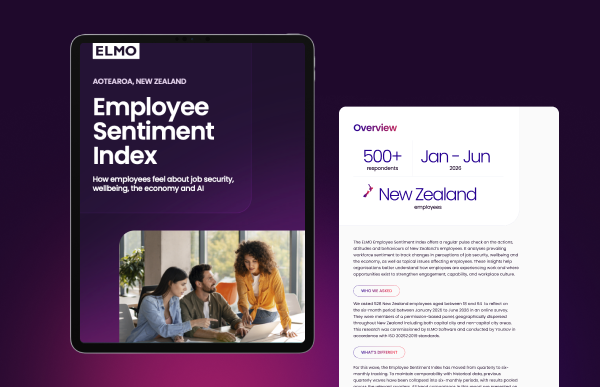
What is the ELMO Employee Sentiment Index Report 2026
The ELMO Software Employee Sentiment Index (ESI) is New Zealand’s biannual pulse check on tracking how employees feel about job security, financial wellbeing and AI in the workplace. It includes analysis across AI adoption, employee wellbeing, job security, financial sentiment, recognition, and workforce mobility, with trend data from H1 2024 to H1 2026. This research was commissioned by ELMO Software and conducted by YouGov in accordance with ISO 20252:2019 standards.
The AI readiness gap in New Zealand
AI has moved from novelty to normal in New Zealand workplaces but confidence, clarity and support haven’t kept pace. Employees feel pressure to use it well but lack the confidence that their employers are actively equipping them. Many also feel uncertain about how to use AI appropriately and whether their skills will still matter in the years ahead. This gap between AI expectation and support is the defining workforce challenge of 2026.
Top insights at a glance
AI is now part of everyday work
- 65% of New Zealand employees use AI tools at work
- 34% using them regularly, as part of repeatable workflows or to automate aspects of work
Employees see AI as both an opportunity and a source of pressure
- 62% agree that if AI helps employees work faster, more is expected of them
- 58% believe using AI effectively is now an expected workplace skill and 53% think those who don’t use AI effectively risk falling behind
Concerns about how AI is used remain
- Two in five (39%) employees report feeling uncomfortable about how AI tools have been used at work
- While most see AI as a tool that can support their role, many believe the conditions for using it responsibly are not yet fully in place
Future skills and workforce readiness are in question
- Just 25% of employees are very confident they know which of their current skills will still matter in two years’ time
- Only 17% believe their employer is doing very well at keeping their skills relevant for AI‑driven change
Financial pressure is still real
- Half (51%) of New Zealand employees say they earn enough to meet their financial needs but most of these are only just managing.
- 49% feel they aren’t earning enough, including 11% who say they are nowhere near earning enough to meet their financial needs
Burnout is easing, but strain remains
- Burnout has declined to 42% (from 47% in H2 2025), and more employees are taking sick leave when they need it
- However, 44% still report working while unwell, and annual leave usage remains flat, suggesting underlying pressures haven’t fully eased
Job fears are easing, but caution is high
- 39% of employees feel they need to work harder or longer hours to keep their job safe, down from 45% in H2 2025
- Concern about redundancy has declined to 35% (from 39% in H2 2025), but more than half of employees take a cautious, middle‑ground view of their economic security
How HR leaders can use the report:
- Benchmark your organisation against the latest New Zealand workforce data across wellbeing, job and economic security, recognition, AI and more.
- Understand where AI pressure and anxiety may be creating engagement, capability and retention risks in your workforce.
- Build the case for investment in reskilling, AI literacy and responsible AI governance.
- Identify the wellbeing, financial and career signals your New Zealand employees are sending right now and where to focus next.
Read the H1 2026 Employee Sentiment Index Report
 By industry
  By role
  By use case
  Customer Success
  Implementation
  Training & Development
  Partner Program
  Partner Finder
  Flare Employee Benefits

 Platform
  Hire
Hire  Schedule
  Pay
Pay  Develop
  Plan
Plan