By industry
  By role
  By use case
  Customer Success
  Implementation
  Training & Development
  Partner Program
  Partner Finder
  Flare Employee Benefits
 9 things to know about ELMO’s two-way sync between HR and Payroll
Say goodbye to entering the same information in multiple systems. ELMO’s payroll two-way sync now…
 Platform
  Hire
Hire  Schedule
  Pay
Pay  Develop
  Plan
Plan With our newest product ELMO insights preparing to launch, we sat down with our Chief People Officer, Anne Tosky to talk about what real-time workforce insights means for her, and why this shift matters so deeply for HR leaders.
There’s a particular kind of dread most HR leaders know well.
You walk into a board meeting with a well prepared pack. You’ve answered the questions you were asked to prepare. You’re ready.
Then the conversation shifts:
You know the answers exists. But you also know they’re spread across systems, spreadsheets and people. Getting a reliable answer means time, coordination and follow up.
So HR falls back on a familiar line.
“I’ll have to get back to you on that.”
For Anne, this isn’t hypothetical – it’s a lived experience.
“There’s a board meeting, you’ve done what you were explicitly asked to do, but you know there could always be a left‑field question: ‘What’s going on with time to fill? What’s going on with hiring quality? What’s going on with attrition?’ In your heart of hearts, you know you’ll have to go and ask someone else, and they’ll need time to get back to you.”
Anne Tosky, Chief People Officer
For decades, that gap between the question and the answer has limited HR’s influence.
Today, that gap is finally starting to close.
For years, HR has talked about “moving from admin to strategy”. In reality, many teams are still spending large parts of their day on:
None of this disappears. Compliance and process will always matter. But they don’t elevate HR’s role.
Anne draws a clear distinction:
The real shift happens when HR can:
Imagine being able to say,
“Our attrition rate last quarter was 14%, but the risk isn’t evenly spread. One manager’s team is trending upwards with exits linked to workload. Certain roles are experiencing higher turnover and longer vacancy periods than comparable roles elsewhere in the business.
Here are the actions we can take now to prevent this escalating.”
That’s the difference between an administrative function and an intelligence function.
And for Anne, the emotional weight of that change is signficant:
Every time HR has to leave the room to “get back” with an answer, there’s a cost:
When HR can answer confidently in the moment, or enable leaders to explore the data themselves, three things change.
“You sit in a board room knowing that at any moment someone might say, ‘What’s going on with time to fill?’ And you just know you’re going to have to ask someone else and wait. The anxiety of anticipating which question might come up and which piece of data you’ll need so you don’t lose credibility – it’s overwhelming. Having answers at your fingertips changes that feeling.”
Anne Tosky, Chief People Officer
This shift isn’t about working harder. It’s about the foundations finally being in place.
Instead of information living in silos – recruitment in one system, learning in another, payroll somewhere else, HR has a single source of truth.
Headcount, budgets, onboarding, performance, turnover, learning are connected, current and consistent.
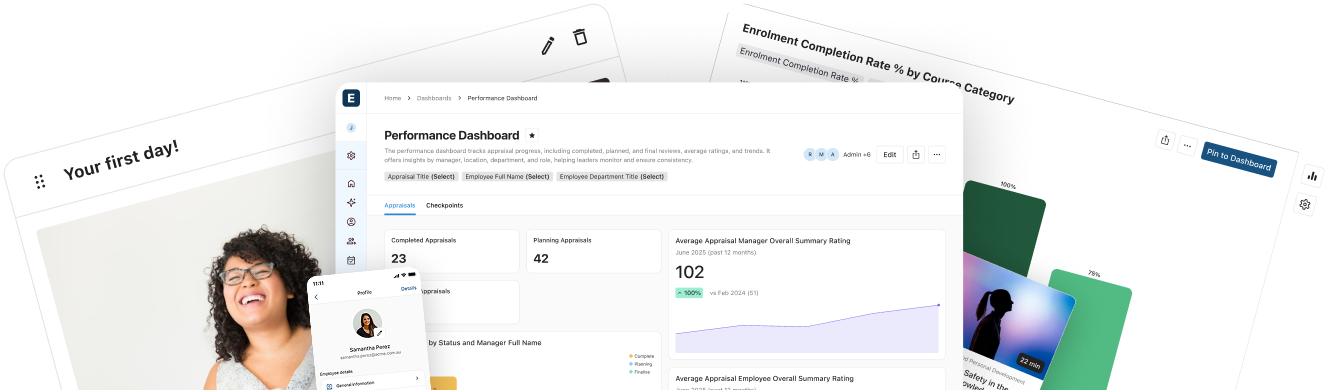
ELMO Insights is designed to be the intelligence layer of ELMO’s next-generation HR platform.
It allows HR leaders to:
There’s no need for SQL or a dedicated analyst for every question, just strong governance and the right platform.
“The dream is: if there’s one question you repeatedly get asked, you can have the answer at your fingertips. In a world of AI‑powered insights, that’s no longer a fantasy – it’s something HR can genuinely expect from their tools.” – Anne Tosky, Chief People Officer
Democratised insights don’t mean a free‑for‑all.
With role‑based access, people see:
That’s how line managers make better decisions, without compromising sensitive information.
Not every strategic question will be answered instantly. Some will always require deeper analysis or external data. But far fewer conversations end with, “We’ll have to get back to you.”
HR professionals have been talking about this shift since the early 2000s:
For years, the technology simply wasn’t ready.
Now it’s realistic to imagine a world where:
“Can you just imagine the different conversations we could be having, the different things we could be doing, the decisions we could make in the moment? Instead of ‘I’ve got to get back to you,’ it becomes, ‘Here’s what’s happening, and here’s what I recommend.’ That’s the future HR has been working towards.”
Anne Tosky, Chief People Officer
The line “I’ll get back to you” won’t disappear forever. There will always be complex questions that deserve deeper work.
But the baseline expectation is changing.
The HR teams that embrace real-time workforce insights now will help shape strategy—not just report on it after the fact.
And that may be the most important shift of all: moving from explaining yesterday to guiding what happens next.
Watch the replay of our ELMO Insights demo, or book a call with our team to explore what real-time workforce intelligence could look like for your organisation.