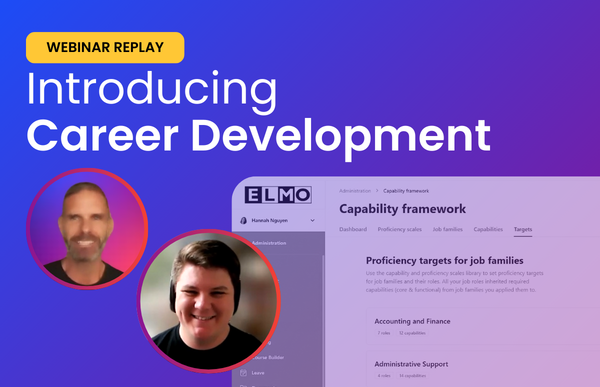
Introducing Career Development
Career development is the number one reason people leave, yet most HR teams are still building capability frameworks in spreadsheets that take months to stand up. In this session, we show you how ELMO’s Career Development uses AI to generate capability frameworks, identify skill gaps, and create personalised learning, in a fraction of the time.
Your questions answered
We get it. AI needs to earn trust. Career Development uses your own position descriptions as the foundation, and HR reviews and approves everything before it goes live. During pilots, customers rated AI accuracy 8-9 out of 10 and told us the frameworks closely matched what they’d built manually or with consultants.
That’s great. You’re ahead of most organisations. The real challenge isn’t creating frameworks, it’s connecting them to action. Career Development takes frameworks from static documents and turns them into live assessments, gap analysis, and personalised learning plans. It’s about making what you’ve built actually drive development.
It’s not. Career Development is purely developmental; assessments inform learning paths, not performance ratings. That distinction matters because employees engage differently when they know it’s about growth, not evaluation.
Assessments take about 10-15 minutes per employee, and the structured framework makes them straightforward to complete. Plus, managers save time overall because AI handles the gap analysis and generates learning recommendations automatically—no spreadsheets, no manual follow-up.
Traditional LMS content serves everyone the same programs. Career Development connects individual capability gaps directly to targeted learning. Instead of “here’s what’s available,” it’s “here’s what you specifically need to develop, and here’s how to do it.”
The AI derives job families and functional capabilities from whatever roles and position descriptions you already have in HR Core.
It identifies your industry and org structure and groups similar roles into families (e.g. Finance, Customer Service, Engineering), then generates core and functional capabilities for each family automatically.
That means for retail organisations, as long as roles like eCommerce, buying and planning, and retail store roles exist with reasonable position descriptions, the system will generate functional capabilities for them.
No – Career Development does not replace Performance appraisals; it is explicitly positioned as development-focused, not performance management, and assessments inform learning paths rather than employee ratings.
In fact, Performance is recommended to maximise value, with Career Development feeding development plans into Performance review cycles so managers can track improvement over time.
Today, Career Development does not pull data from the Performance module; the documented integration is the other way around, with personalised development plans from Career Development flowing into an individual’s development goals in Performance appraisals.
Feeding capabilities or development needs from existing Performance reviews back into Career Development’s capability framework is described only as a future roadmap vision, not a current feature.
Career Development works best when you have good position-led HR Core data, a clear organisation-wide proficiency scale, and HR/SME capacity to review AI-generated frameworks, using the mandatory stack of HR Core Platform (or HR Core with Position Led), Survey and Learning.
The “make or break” factors are quality of role descriptions, willingness to tune AI output (especially for niche/regulated capabilities), and having a solid learning catalogue; weak job data or skipping human review will undermine value.
Set-up from scratch is relatively light on system config (about 30 minutes to set proficiency scales and ~5–6 minutes for AI generation even on large sites), with the main overhead being 30–40 minutes of SME time per role to refine frameworks plus 10–15 minutes per employee for managers to assess and review learning plans; commercial cost is tied to having the required ELMO modules rather than a separate Career Development SKU.
Career Development is unlocked for customers that have HR Core (with position-led), Learning & Survey. You do not need to purchase it additionally.
No – you must have the ELMO Learning module, but you do not need to purchase ELMO’s Course Library; Career Development connects capability gaps create personalised learning courses.
Career Development doesn’t ship with a static, generic competency library; instead, the AI builds role-specific core and functional capabilities for each customer from their own position data during initial setup, rather than using pre-made templates.
The AI suggests 5–8 core competencies per role and identifies the relevant functional capabilities for each job family, then admins can review, edit, add or remove items to finalise their capability framework.
Yes – Career Development’s AI-generated capability frameworks are a starting point that you can fully customise, including editing capability descriptions, adding organisation-specific competencies/capabilities, adjusting proficiency levels, and aligning to your existing performance and industry requirements.
No – the career developement fuctionality is not currently intergrated with LinkedIn to recommend courses. The AI generates personalised learning plans from capability gaps using content available via ELMO Learning module, following a 70-20-10 development model.
ELMO Career Development is based on the PositionLed structure created within the ELMO HR Core Position & Role Libraries. Bulk uploads make it possible to mirror your current structure. The Capability Framework will need to be edited to match your current mapping and competency assessments.
The AI will help generate the initial grouping for the Leadership Job Family, and help define any functional and core capabilities. This is based on the information in the ELMO HR Core Position Library.
Currently assessments are manager-led only, with managers evaluating team members against role-specific capabilities via the Survey module.
Employee self-assessment is on the roadmap and coming next quarter.
Career Development is region-agnostic, allows you to incorporate industry-specific requirements and competencies, and that across seven pilot organisations the AI-generated frameworks closely mirrored existing frameworks and should always reviewed and approved by HR before rollout. However please note that the ELMO Career Development tool is not designed to replace or audit highly regulated environments.
The AI does not currently auto-scan or auto-map your existing library to find “close enough” courses, so aged-care-specific training would need to be incorporated/configured within your Learning module and then used as part of the personalised plans rather than being automatically inferred from content alone.
HR Core